
Regulation EC – Vehicle Compliance Services
Regulation (EC) means “European Community Regulation.”
What does “(EC)” mean?
The letters in the brackets tell you which legal entity issued the law and when:
EC (European Community): Laws passed before the Treaty of Lisbon (2009) are labeled (EC). This was the period when the EU was legally referred to as the European Community for economic matters.
EU (European Union): Laws passed after December 2009 are labeled Regulation (EU).
EEC: Even older laws (pre-1993) were labeled Regulation (EEC) for the European Economic Community.
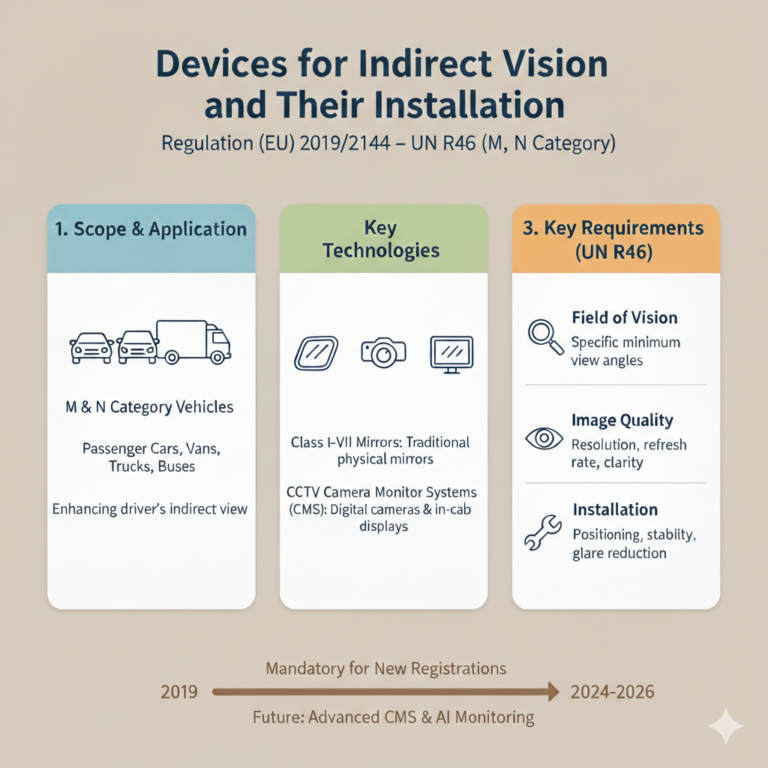
Devices for Indirect Vision and Their Installation – Regulation (EU) 2019/2144 – UN R46 (M, N Category)
Overview
UN Regulation R46 under Regulation (EU) 2019/2144 defines the technical and installation requirements for devices for indirect vision, such as rear-view mirrors and camera-monitor systems, fitted on M and N category vehicles. The regulation aims to improve driver visibility by reducing blind spots and enhancing situational awareness in normal driving and manoeuvring conditions.
Purpose & Compliance
The regulation specifies performance, field of vision, durability, and installation criteria to ensure reliable indirect vision systems without compromising vehicle safety. Compliance with UN R46 supports harmonized type approval, helps manufacturers integrate advanced visibility technologies, and contributes to improved road safety for all road users.
Braking of Vehicles and Trailers – UN R13 & UN R13-H
Overview
Regulation (EU) 2019/2144, together with UN R13 and UN R13-H, sets the technical requirements for braking systems in vehicles and trailers. UN R13 applies to M2, M3, N, and O category vehicles, covering service brakes, secondary brakes, and parking brakes, ensuring reliable performance and vehicle stability during operation.
Passenger Car Braking – UN R13-H
UN R13-H focuses on passenger cars (M1) and light commercial vehicles (N1 category), specifying performance, durability, and safety standards for braking systems. Compliance with both regulations ensures harmonized type approval, enhances road safety, and guarantees consistent braking performance across all vehicle types and categories.
Interior Fittings – UN R21 (M1 Category) | Regulation (EU) 2019/2144
Overview
UN Regulation R21 under Regulation (EU) 2019/2144 defines safety and performance requirements for interior fittings in M1 category vehicles (passenger cars). The regulation ensures that seats, panels, grab handles, and other interior components are designed and installed to minimize the risk of injury to occupants during normal use and in the event of a collision.
Purpose & Compliance
The regulation covers aspects such as strength, positioning, durability, and flammability of interior fittings. Compliance with UN R21 helps manufacturers achieve harmonized type approval, enhances passenger safety, and ensures that vehicle interiors meet stringent EU safety standards.
Vehicle Security and Driver Safety – UN R18 & UN R12 | Regulation (EU) 2019/2144
Protection Against Unauthorized Use – UN R18
UN Regulation R18 under Regulation (EU) 2019/2144 specifies safety and anti-theft requirements for motor vehicles in M2, M3, N2, and O categories. It ensures that vehicles are equipped with effective protection systems to prevent unauthorized access or use, enhancing overall vehicle security and reducing theft-related risks for passenger transport and commercial vehicles.
Driver Protection During Impact – UN R12
UN Regulation R12 focuses on protecting the driver against the steering mechanism during a collision for M1 and N1 category vehicles (passenger cars and light commercial vehicles). This regulation requires steering components to be designed and installed in a way that minimizes the risk of injury to the driver during frontal or offset impacts.
Purpose and Compliance
Together, UN R18 and UN R12 ensure comprehensive vehicle safety, covering both security against unauthorized use and occupant protection in the event of an accident. Compliance with these regulations supports harmonized type approval, enhances road safety, and ensures vehicles meet strict EU safety standards across passenger and commercial categories.
Seats, Anchorages, and Head Restraints – UN R17 | Regulation (EU) 2019/2144
Overview
UN Regulation R17 under Regulation (EU) 2019/2144 sets the safety and performance requirements for seats, seat anchorages, and head restraints in M and N category vehicles. The regulation ensures that seating systems are securely installed, provide adequate support, and minimize the risk of injury to occupants during normal use and in the event of a collision.
Purpose & Compliance
The regulation covers aspects such as seat strength, proper anchorage, durability, and head restraint effectiveness. Compliance with UN R17 helps manufacturers achieve harmonized type approval, enhances passenger safety, and ensures vehicles meet strict EU regulatory standards for seating systems in passenger and commercial vehicles.
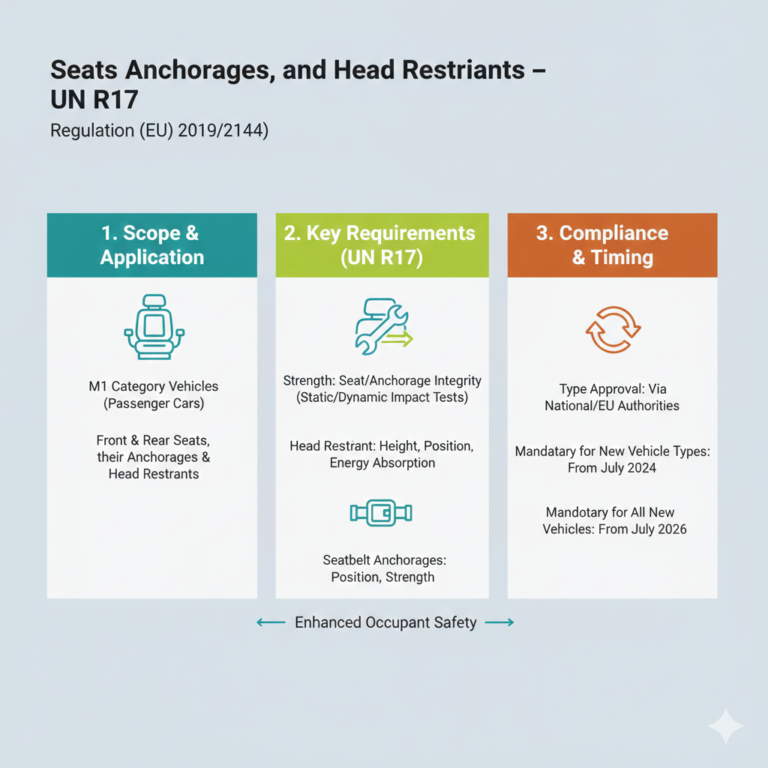
Seats, Anchorages, and Head Restraints – UN R17 | Regulation (EU) 2019/2144
Overview
UN Regulation R17 under Regulation (EU) 2019/2144 sets the safety and performance requirements for seats, seat anchorages, and head restraints in M and N category vehicles. The regulation ensures that seating systems are securely installed, provide adequate support, and minimize the risk of injury to occupants during normal use and in the event of a collision.
Purpose & Compliance
The regulation covers aspects such as seat strength, proper anchorage, durability, and head restraint effectiveness. Compliance with UN R17 helps manufacturers achieve harmonized type approval, enhances passenger safety, and ensures vehicles meet strict EU regulatory standards for seating systems in passenger and commercial vehicles.
External Projections – UN R26 | Regulation (EU) 2019/2144 (M1 Category)
Overview
UN Regulation R26 under Regulation (EU) 2019/2144 specifies requirements for external projections on M1 category vehicles (passenger cars). The regulation ensures that all exterior components, such as bumpers, mirrors, and other protruding parts, are designed to minimize the risk of injury to pedestrians and other road users in the event of a collision.
Purpose & Compliance
The regulation addresses the size, shape, and strength of external projections, ensuring they are safe, durable, and compliant with vehicle design standards. Compliance with UN R26 supports type approval, enhances pedestrian safety, and ensures vehicles meet EU safety regulations for passenger cars.
Installation of Lighting and Light-Signalling Devices – UN R48 | Regulation (EU) 2019/2144 (M, N, O Category)
Overview
UN Regulation R48 under Regulation (EU) 2019/2144 defines the requirements for the installation of lighting and light-signalling devices on M, N, and O category vehicles, including passenger vehicles, goods vehicles, and trailers. The regulation ensures that headlights, taillights, indicators, and other signal lamps are correctly positioned, visible, and functional to provide safe communication between vehicles on the road.
Purpose & Compliance
The regulation covers the arrangement, height, orientation, intensity, and durability of lighting and signalling devices. Compliance with UN R48 ensures vehicles meet harmonized type approval standards, improves road safety by enhancing vehicle visibility, and supports adherence to EU safety regulations across all vehicle categories.
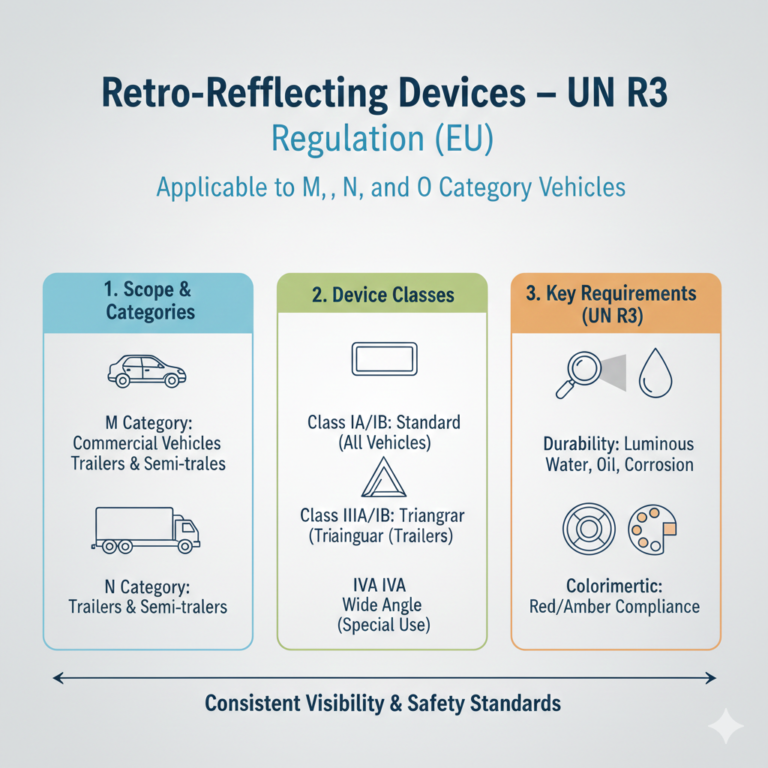
Retro-Reflecting Devices – UN R3 | Regulation (EU) 2019/2144 (M, N, O Category)
Overview
UN Regulation R3 under Regulation (EU) 2019/2144 specifies requirements for retro-reflecting devices on M, N, and O category vehicles, including passenger vehicles, goods vehicles, and trailers. These devices enhance vehicle visibility in low-light conditions, ensuring other road users can clearly see the vehicle from a distance and reducing the risk of accidents.
Purpose & Compliance
The regulation defines the placement, color, intensity, and durability of retro-reflecting devices to meet safety standards. Compliance with UN R3 ensures that vehicles achieve harmonized type approval, improve road safety, and conform to EU regulations for visibility and accident prevention.
Lateral Protection of Goods Vehicles – UN R73 | Regulation (EU) 2019/2144 (N2, N3, O3, O4 Categories)
Overview
UN Regulation R73 under Regulation (EU) 2019/2144 establishes safety requirements for the lateral protection of goods vehicles, covering N2, N3, O3, and O4 category vehicles, including medium and heavy goods vehicles and trailers. The regulation is designed to reduce the risk of serious injuries to vulnerable road users, such as cyclists and pedestrians, by preventing them from being trapped under the vehicle in side collisions.
Purpose & Compliance
The regulation specifies technical requirements for the design, strength, and installation of side underrun protection systems, ensuring they are effective under normal operating conditions. Compliance with UN R73 helps manufacturers achieve harmonized type approval, enhances road safety for all traffic participants, and ensures goods vehicles meet stringent EU safety standards for lateral protection.
Front Underrun Protective Devices – UN R93 | Regulation (EU) 2019/2144 (N2, N3 Categories)
Overview
UN Regulation R93 under Regulation (EU) 2019/2144 defines the technical and installation requirements for Front Underrun Protective Devices (FUPD), also known as Front Underrun Protection (FUP), on N2 and N3 category vehicles (medium and heavy goods vehicles). The regulation is designed to prevent smaller vehicles from sliding underneath the front of larger trucks during collisions, reducing the severity of accidents and enhancing road safety.
Purpose & Compliance
The regulation specifies performance, strength, and installation criteria for front underrun protection systems to ensure effective energy absorption during impact. Compliance with UN R93 enables manufacturers to meet EU type approval requirements, improve crash safety, and protect occupants of other vehicles in front-end collisions.
FAQs – Regulation (EC) Vehicle Compliance Services
Regulation (EC) vehicle compliance services help manufacturers and automotive suppliers understand and meet applicable European vehicle safety, performance, testing, and type approval requirements. Kanifnath Enterprises supports compliance across regulations such as UN R46, R13, R21, R17, R26, R48, R73 and R93.
The compliance framework covers multiple vehicle safety areas, including braking systems, indirect vision, interior fittings, seats and head restraints, lighting, retro-reflective devices, lateral protection, and underrun protection.
Yes. Kanifnath Enterprises provides compliance support to help manufacturers meet applicable technical requirements and support harmonized vehicle type approval processes.
UN R13 covers braking requirements for M2, M3, N and O category vehicles, while UN R13-H focuses on braking requirements for M1 passenger cars and N1 light commercial vehicles.
Depending on the vehicle category and applicable regulation, compliance can cover systems such as indirect vision, braking, lighting, seats, external projections, underrun protection, fuel-system safety and vehicle access systems.