
How to Get ECE Type Approval for Your Vehicle in India — Step by Step
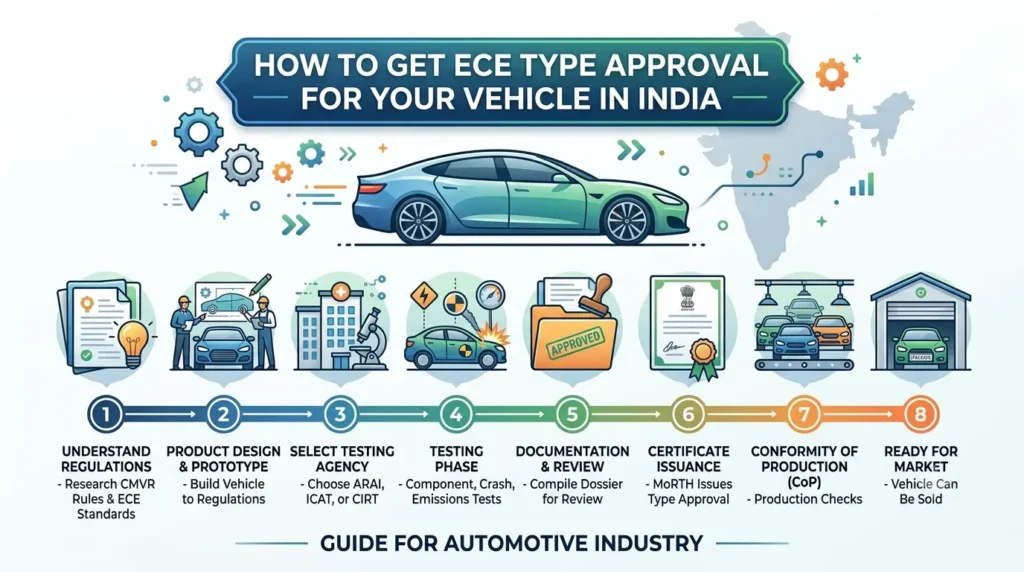
The automotive industry in India is rapidly evolving, with manufacturers striving to meet global safety and environmental standards. One crucial certification for vehicles and components is the ECE type approval process India. This approval ensures compliance with international regulations under the United Nations Economic Commission for Europe (UN-ECE) framework, making vehicles eligible for both domestic use and export.
For manufacturers, suppliers, and even startups in the electric vehicle (EV) sector, understanding the step-by-step process of ECE type approval is essential. Let’s break it down.
What is ECE Type Approval?
ECE type approval is a homologation process that certifies vehicles and components against safety, performance, and environmental standards. In India, this is governed by the Central Motor Vehicle Rules (CMVR) and overseen by the Ministry of Road Transport and Highways (MoRTH).
Without type approval, a vehicle cannot be registered or sold legally. For exporters, it’s the gateway to international markets.
Why ECE Type Approval Matters
-
Market Access: Vehicles can be exported to Europe and other UN-ECE compliant regions.
-
Consumer Safety: Ensures compliance with crash safety, emissions, and performance standards.
-
Legal Compliance: Mandatory under CMVR Rule 126 for all new models and variants.
-
Brand Credibility: Builds trust with customers, partners, and regulators.
Step-by-Step Process for ECE Type Approval in India
Step 1: Identify Applicable Standards
Each vehicle type (two-wheeler, four-wheeler, EV, commercial vehicle) has specific UN-ECE regulations. Manufacturers must identify which standards apply to their product.
Step 2: Select an Authorized Testing Agency
India has several authorized agencies:
-
ARAI Pune – Automotive Research Association of India
-
ICAT Manesar – International Centre for Automotive Technology
-
VRDE Ahmednagar – Vehicle Research & Development Establishment
Step 3: Submit Documentation
Manufacturers must provide:
-
Technical specifications
-
Design drawings
-
Safety features
-
Emission data
-
Compliance declarations
Step 4: Vehicle Testing
The agency conducts rigorous tests, including:
-
Crash safety tests
-
Emission and fuel efficiency tests
-
Noise and vibration analysis
-
Component-level testing (brakes, lights, tires, etc.)
Step 5: Review and Certification
If the vehicle passes all tests, the agency issues a Type Approval Certificate. This certificate is recognized by MoRTH and international regulators.
Step 6: Post-Approval Compliance
Manufacturers must maintain compliance through periodic audits, batch testing, and reporting.
Challenges in the Approval Process
-
Documentation Errors: Incomplete or inaccurate paperwork can delay approval.
-
Testing Delays: Limited slots at agencies may extend timelines.
-
Cost Factor: Certification involves significant investment in testing and compliance.
-
Regulatory Updates: Standards evolve, requiring manufacturers to stay updated.
Tips for Smooth Approval
-
Engage with consultants familiar with homologation.
-
Prepare documentation thoroughly before submission.
-
Choose the right testing agency based on vehicle type.
-
Plan for timelines and budget accordingly.
Conclusion
The ECE type approval process in India is a critical step for automotive manufacturers aiming to ensure safety, compliance, and global market access. While the process may seem complex, following a structured approach makes it manageable.
About Kanifnath Enterprises –
At Kanifnath Enterprises, we specialize in providing end-to-end solutions for ECE type approval process India. With increasing government regulations and strict enforcement of international safety standards, ensuring compliance is no longer optional—it is essential for legal operations and global market access.
We help vehicle manufacturers, fleet operators, and automotive startups understand and implement critical requirements such as UN-ECE regulations, CMVR certification, emission standards, crash safety compliance, and component-level homologation mandated under Indian and international frameworks.
Our expert team offers complete support—from compliance audits and documentation to testing coordination, safety upgrades, and implementation guidance—ensuring your vehicles meet all required legal and safety benchmarks. Whether you are preparing for domestic registration or aiming to export vehicles to Europe and beyond, Kanifnath Enterprises provides the expertise and reliability to make the approval process seamless.
 Previous Post
 Next Post