
Regulation EU GSR Compliance
Regulation (EU) 2019/2144: GSR Compliance and Type Approval Support
ATS IPL helps vehicle manufacturers and component makers meet the General Safety Regulation through testing, technical documentation and certification coordination for WVTA, IWVTA and national type approval.
What is Regulation (EC) / (EU) 2019/2144?
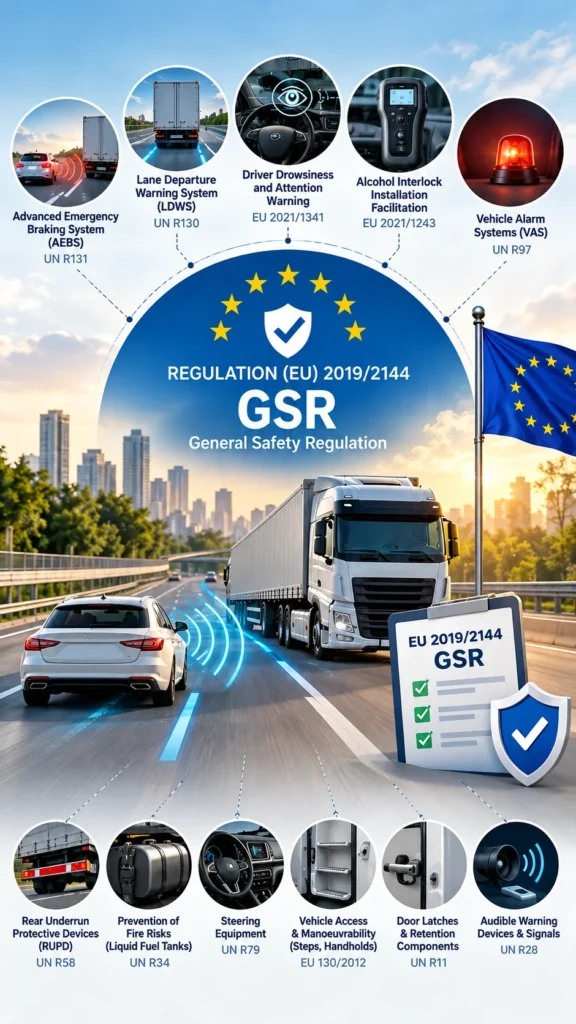
Regulation (EU) 2019/2144 is the European General Safety Regulation (GSR). It lists the safety systems that new vehicles must carry to receive type approval, and it refers to many UN regulations and delegated EU acts for the technical test requirements.
(EC) or (EU)? Many older documents and search queries still write “Regulation (EC) 2019/2144”. Acts adopted after the Treaty of Lisbon (December 2009) carry the label (EU), and acts adopted before 1993 carry (EEC). The 2019/2144 text is formally a Regulation (EU), and the table below uses the common industry reference.
For manufacturers exporting to Europe, or aligning with global regulations, national regulations and international standards, GSR compliance is a basic condition of type approval.
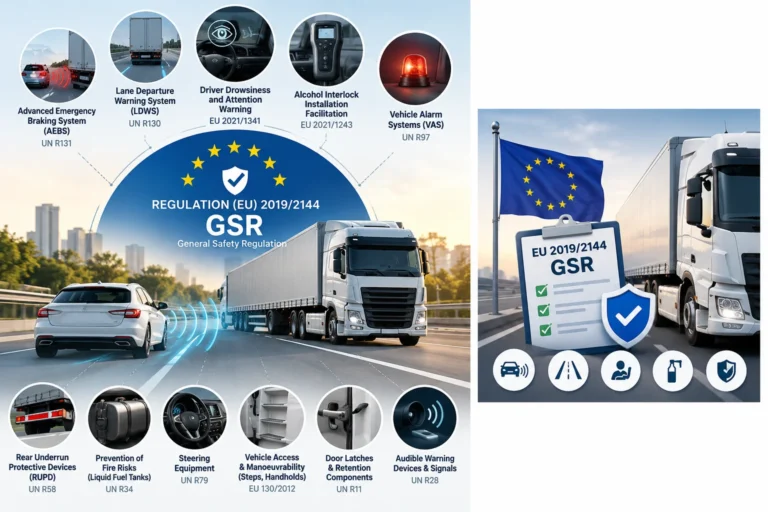
| Regulation | Requirement |
|---|---|
|
Regulation (EU) 2019/2144 + UN R131
|
Advanced Emergency Braking System (AEBS) |
|
Regulation (EU) 2019/2144 + UN R130 |
Lane Departure Warning System (LDWS) |
|
Delegated Regulation (EU) 2021/1341 |
Driver drowsiness and attention warning |
|
Delegated Regulation (EU) 2021/1243 |
Alcohol interlock installation facilitation |
|
Regulation (EU) 2019/2144 + UN R97 |
Vehicle Alarm Systems (VAS) |
|
Regulation (EU) 2019/2144 + UN R58 |
Rear Underrun Protective Devices (RUPD) |
|
Regulation (EU) 2019/2144 + UN R34 |
Prevention of fire risks (liquid fuel tanks) |
|
Regulation (EU) 2019/2144 + UN R79 |
Steering equipment
|
|
Regulation (EU) No 130/2012 |
Vehicle access and manoeuvrability (steps, running boards, handholds) |
|
Regulation (EU) 2019/2144 + UN R11 |
Door latches and door retention components |
|
Regulation (EU) 2019/2144 + UN R28 |
Audible warning devices and signals |
|
UNECE R100 |
Electric vehicle safety requirements |
Advanced Emergency Braking System (AEBS), UN R131 (M2, M3, N2, N3 category)
AEBS is a safety layer that helps prevent or reduce rear-end collisions. Radar, LiDAR or camera sensors detect a vehicle ahead, the system warns the driver, and if the driver does not respond it brakes automatically. Under Regulation (EU) 2019/2144, AEBS is mandatory on these heavy vehicle categories, and UN R131 defines how it is tested.
Key requirements
- Collision warning to the driver before automatic braking starts
- Automatic braking against stationary and moving targets at defined speeds
- Detection of system faults, with a warning to the driver
- Proof of performance through track tests and technical documentatio
How ATS IPL supports you
- ADAS test planning with soft targets and driving robots
- Data acquisition, GPS/IMU measurement and result analysis
- Test report and technical file for the approving authorit
Lane Departure Warning System (LDWS), UN R130 (M2, M3, N2, N3 category)
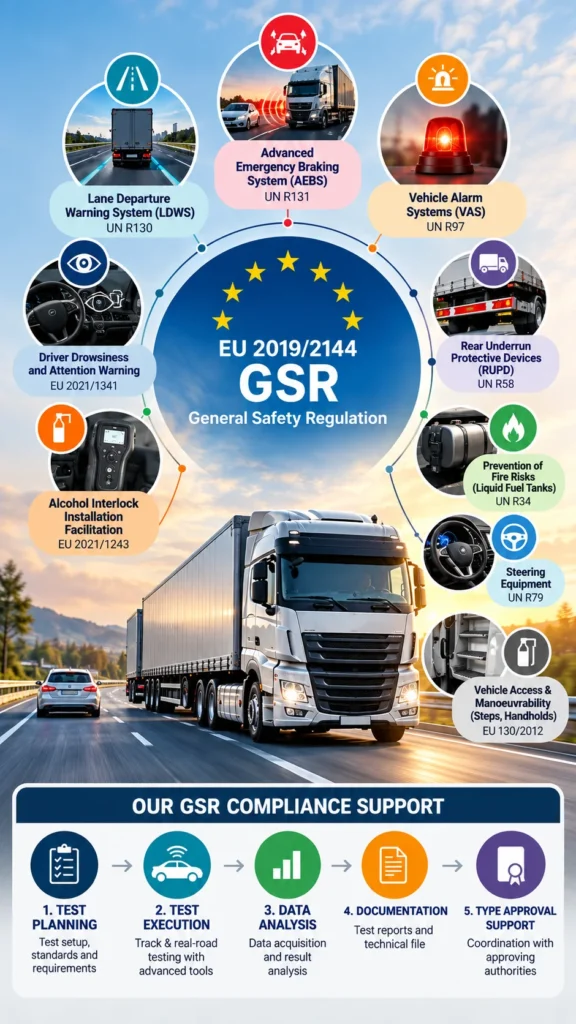
A Lane Departure Warning System alerts the driver when the vehicle unintentionally drifts out of its lane. The General Safety Regulation requires it on heavy vehicles, and UN R130 sets the test conditions and performance limits.
Key requirements
- Warning when a lane marking is crossed without the direction indicator being used
- No false warning during deliberate lane changes
- Visual failure indication when the system cannot work
- Defined performance on straight roads and curves across the speed range
How ATS IPL supports you
- Test track trials on marked lanes at different speeds and approach angles
- Camera and sensor signal logging for evidence
- Approval documentation and technical support for system supplier
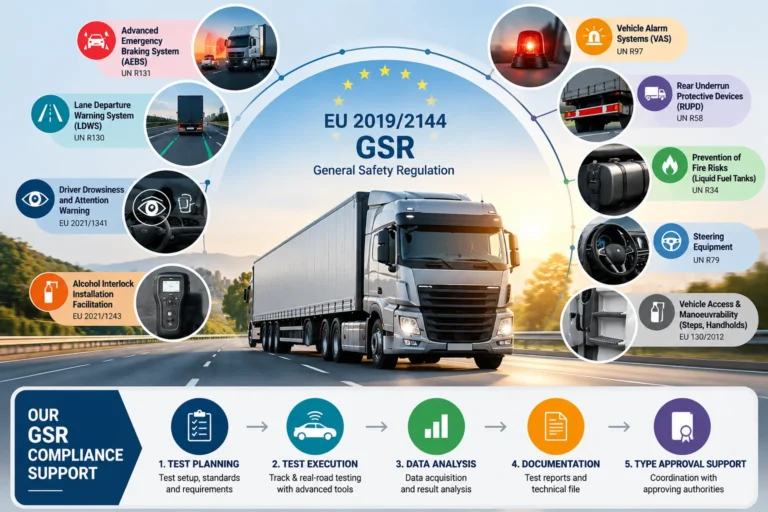
Driver drowsiness and attention warning, Regulation (EU) 2021/1341 (M, N category)
Fatigue and distraction are major causes of road accidents. Commission Delegated Regulation (EU) 2021/1341 sets the technical rules for systems that watch driver behaviour or vehicle signals, detect falling alertness, and warn the driver in time. It is part of the General Safety Regulation package.
Key requirements
- Detection of signs of drowsiness through driving behaviour or driver monitoring
- Clear, timely warning to the driver
- Reliable operation in real driving conditions
- Protection against easy misuse or deactivation
How ATS IPL supports you
- Review of the detection and warning strategy
- Real-road and track validation with data logging
- Technical documentation for type approval
Alcohol interlock installation facilitation, Regulation (EU) 2021/1243 (M, N category)
This delegated regulation does not force every vehicle to carry an alcohol interlock. It requires the vehicle to be ready for one, with a standard interface so a device can be fitted later without disturbing other vehicle functions. This supports drink-driving prevention programmes across EU states.
Key requirements
- Standardised electrical and mechanical interface (referring to the EN 50436 series)
- Safe integration without affecting other safety systems
- Documented installation points and instructions
How ATS IPL supports you
- Review of interface design, wiring and installation documents
- Compatibility checks with typical interlock devices
- Guidance for OEMs and fleet operator
Vehicle Alarm Systems (VAS), UN R97 (M1, N1 category)
M1 means passenger cars carrying up to eight passengers plus the driver, and N1 means light goods vehicles up to 3.5 tonnes. UN R97 protects these vehicles from theft and unauthorised entry by setting rules for how an alarm system must work.
Key requirements
- Alarm triggered by unauthorised entry or movement
- Limits on siren sound level and duration
- Reset behaviour and protection against false alarms
- Reliable electrical performance and tamper resistance
How ATS IPL supports you
- Functional and sound tests
- Review of system design and installation
- Documentation for type approval
Rear Underrun Protective Devices (RUPD), UN R58 (M, N, O category)
Underrun accidents happen when a car slides beneath the rear of a truck or trailer. A Rear Underrun Protective Device (RUP) is a strong rear bar that blocks the car and lets its own safety systems work. UN R58 covers the device and its installation on goods vehicles and trailers.
Key requirements
- Limits on width, ground clearance and section height
- Strength under defined test forces without excessive deformation
- Secure mounting and correct position on the vehicle
- Clear marking and approval documents
How ATS IPL supports you
- Static load test planning and measurement
- Design and fitment review for body builders and trailer makers
- Coordination with the approving authority
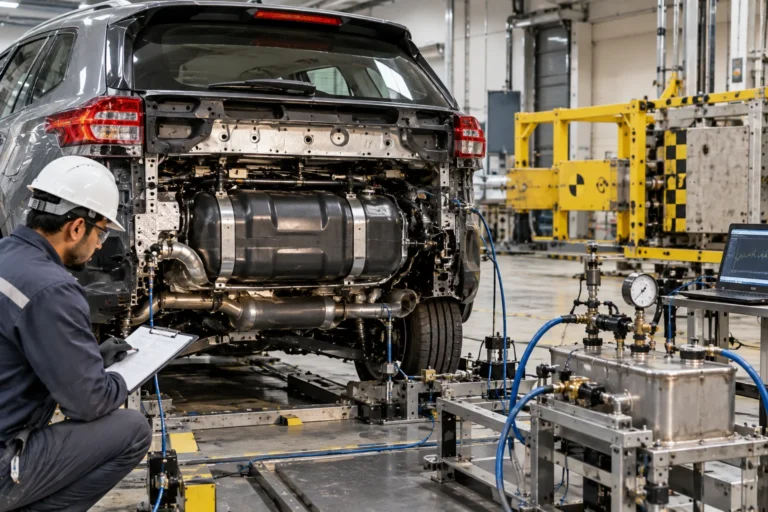
Prevention of fire risks, liquid fuel tanks, UN R34 (M, N, O category)
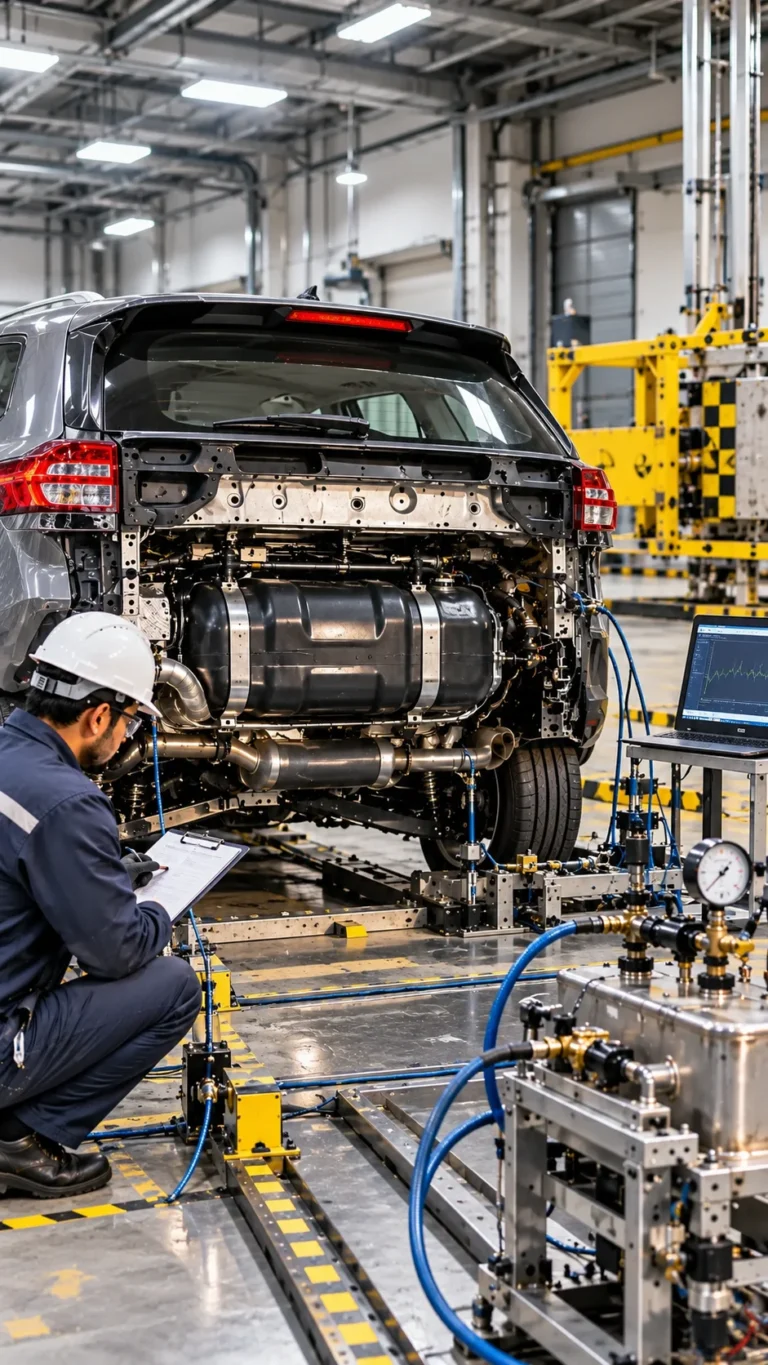
UN R34 aims to reduce fuel leakage, ignition and fire in normal use and after a crash. It applies to passenger vehicles, goods vehicles and trailers, and covers both the fuel tank and its installation.
Key requirements
- Fuel tank strength, leak tightness and internal pressure resistance
- Fire resistance of tank materials
- Safe tank position and protection on the vehicle
- Controlled fuel venting and filler arrangement
How ATS IPL supports you
- Design review of tanks and fuel system layout
- Guidance on materials and installation
- Support for impact, leakage and fire tests, and type approval submission
Steering equipment, UN R79 (M, N, O category)
UN R79 sets safety rules for steering systems, including power steering, failure behaviour and driver assistance functions that steer the vehicle. The steering must stay controllable and predictable, even if part of the system fails.
Key requirements
- Steering effort and response requirements
- Safe behaviour after a failure in the steering system
- Rules for assisted and automatically commanded steering functions
- Driver warning when the system is limited
How ATS IPL supports you
- Repeatable manoeuvre testing with steering robots
- Vehicle dynamics measurement with IMU and data loggers
- Test reports and certification support
Vehicle access and manoeuvrability, Regulation (EU) No 130/2012 (M1, N category)
Steps, running boards and handholds help occupants get in and out of vehicles safely. Commission Regulation (EU) No 130/2012, used together with Regulation (EU) 2019/2144, defines requirements for these access devices on passenger cars and goods vehicles.
Key requirements
- Correct position, height and size of steps and handholds
- Strength and durability under use
- Safe installation without interfering with vehicle safety systems
- Easy and safe access for the driver and occupants
How ATS IPL supports you
- Interpretation of the regulation for your vehicle
- Review of design, strength and usability
- Technical documents and coordination with testing agencies
Door latches and door retention components, UN R11 (M1, N1 category)
In a crash, doors must stay closed and must open again afterwards so people can leave the vehicle. UN R11 covers the latch, striker and hinge system on passenger cars and light goods vehicles.
Key requirements
- Strength under longitudinal and transverse loads
- Resistance to inertia forces in a crash
- Primary and secondary latch positions
- Operating durability of the components
How ATS IPL supports you
- Door and component test rigs for load and durability tests
- Actuators and force sensors for repeatable measurements
- Test reports for approval
Audible warning devices and signals, UN R28 (M, N category)
The horn is a basic safety signal. UN R28 sets rules for the sound it produces and how the device is built, so it is loud enough to warn others but not harmful.
Key requirements
- Sound pressure level within set limits
- Defined frequency range of the signal
- Durability and stable performance in service
- Correct marking and installation
How ATS IPL supports you
- Sound level measurement and data recording
- Review of the device and its fitment
- Documentation for type approval
How ATS IPL supports your approval
- Gap analysis of your vehicle or component against the GSR and UN regulations
- Test planning and execution in our NABL-aligned laboratory network
- Measurement tools: data loggers, sensors, soft targets and driving robots
- Documentation for WVTA and IWVTA, plus homologation coordination
- Support for OEMs, suppliers and body builders
Frequently asked questions about GSR compliance
Regulation (EU) 2019/2144 is the European General Safety Regulation (GSR). It lists the safety systems that new vehicles must have to get type approval, such as AEBS, lane departure warning, driver drowsiness warning and vehicle alarm systems. It was introduced in phases, starting in 2022 for new vehicle types and 2024 for all new vehicles.
The correct name is Regulation (EU) 2019/2144. Laws passed before the Treaty of Lisbon in 2009 are labelled (EC), and laws passed after it are labelled (EU). Many people still search for "Regulation EC 2019/2144", but both terms refer to the same General Safety Regulation.
M category means passenger vehicles, N category means goods vehicles and O category means trailers. M1 is a passenger car with up to eight seats besides the driver. N1 is a goods vehicle up to 3.5 tonnes. M2, M3, N2 and N3 are the larger buses and trucks, and O covers trailers and semi-trailers.
AEBS under UN R131 applies to M2, M3, N2 and N3 category vehicles, meaning heavier buses and trucks. The system must detect a vehicle ahead, warn the driver, and apply emergency braking automatically if the driver does not react. Manufacturers prove this through track tests and documents submitted for type approval.
WVTA (Whole Vehicle Type Approval) is the European system that approves a complete vehicle design for sale in the EU. IWVTA (International Whole Vehicle Type Approval) is the UNECE system that approves a vehicle against a set of UN regulations, so the approval can be recognised in several participating countries.